
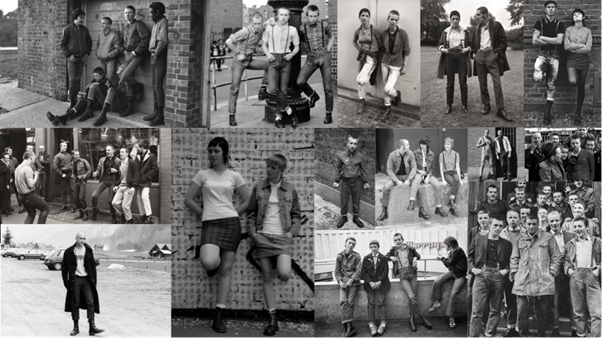
Fashion, particularly in relation to hair style and length, have been engrained in the subculture from its origins, so much so that the Cambridge dictionary defines the term ‘skinhead’ as ‘a young person, especially a man, who has very short hair or no hair and is part of a group, often a violent group’. Skinheads were easily identifiable by their shaven heads and heavy boots (usually Dr. Martens), but the subculture was also characterised by ‘working-class clothing’, referring to button-down or polo shirts, usually paired with high rise jeans or combat trousers, and a denim or bomber jacket.
In terms of music, the second wave of skinheadism saw a notable shift from the traditional Jamaican music at the centre of the 1950s and 60s skinhead culture. It was adapted to more closely align with punk and new wave music, forming a style known as 2 Tone (or Two-tone).
The skinhead subculture originated among the working-class youth in London. Although it should be noted that The National Front was not an identical demographic to those who identified with the skinhead culture, there is certainly overlap, and so data collected by the party on its members may be indicative of skinheads as well. The National Front’s electoral support was overwhelmingly urban, with a vast number of votes coming from London’s north-east suburbs. In his 1977 novel, The National Front, Walker described the areas from which the party was receiving the most support as “respectable working-class”, noting that these areas had traditionally been home to Labour voters, but that they were attracted to the party because of their anti-immigration position.
Young people’s increasing desire to affiliate themselves with a group or movement was initially motivated by working-class solidarity. However, it quickly became polarising and subsequently encouraged skinheads to split into far-right and far-left strands, described as ‘a struggle to define the essence of the subculture, a fight over authenticity’ (Subcultures, Pop Music and Politics: Skinheads and “Nazi Rock” in England and Germany). Far-right organisations such as The National Front became infamous, and even the presence of groups like SHARP (Skinheads Against Racial Prejudice), could not outweigh the damaging influence of their far-right counterparts.
What started as an apolitical group centred around traditionally Jamaican music became politically active. They commonly incited riots and committed racially motivated acts of violence. The popularity of these beliefs also paved the way for numerous neo-Nazi and white supremacist organisations around the world, enabling the spread of a malicious ideology.
The reemergence of skinheadism in the 1980s was pioneered primarily by musicians (notably Gary Hodges and Tom McCourt) who revived the original skinhead style in response to the punk movement of the late 1970s. However, it was not solely about music anymore. The skinhead culture became almost synonymous with The National Front, who used the growing dissatisfaction in the UK to gain electoral support and increase membership.
Leave a Reply